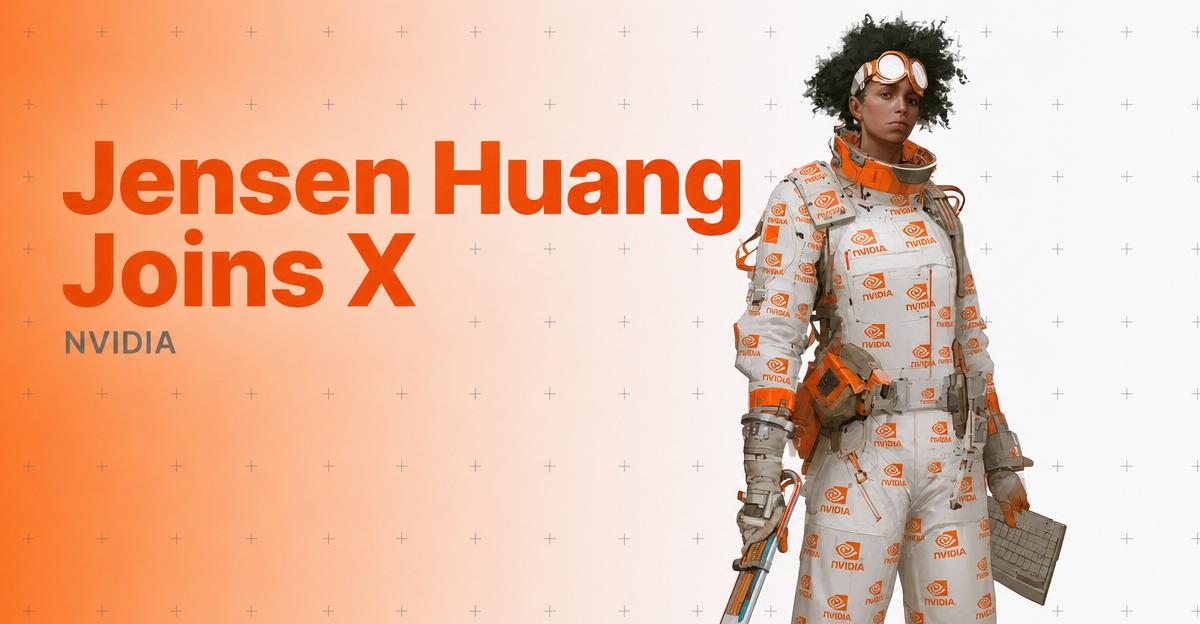
Jensen Huang made his first post on X on July 24, 2026. NVIDIA's founder and CEO has run the most valuable company in the world for years without a personal account on the platform, so the debut drew attention on its own. What he chose to post said more. He skipped the chip and the benchmark and used the moment to make a policy argument, with a document attached.

The post linked to a three-page letter, "Open Weights and American AI Leadership," dated the same day. Within a few hours it had passed 7 million views, with about 45,000 likes, 12,000 reposts, 8,600 bookmarks, and 6,000 replies. The account is a week old, opened in June 2026, and already sits above 200,000 followers with that single post to its name.
The world needs both frontier closed models and frontier open models.
The main thrust: back open weights as national strategy
Strip away the diplomacy and Huang's day-one message is a bet. He is arguing that American AI leadership depends on open-weight models spreading into every sector, not on any one lab's closed frontier model. His own summary is the "both" line above, but the weight of the letter lands on the open side, because that is the part he thinks policy could get wrong.
The letter opens with the history of open-source software: 1980s pioneers who argued code would advance faster in the open, and an ecosystem that now runs most of the internet and underpins systems at the largest tech companies, the U.S. military, and federal research. It casts open-weight models, the kind anyone can download, inspect, modify, and run on their own hardware, as the same kind of foundation for AI.
From there it makes four arguments for open weights:
- Access. A startup or a university can build on an advanced model without training one from scratch or paying frontier prices for routine work, to "match the right model to the right job at the right cost."
- Competition. The gains of AI stay spread across many companies instead of pooling in a few.
- Control. Customers keep their own data and deployment choices, which guards against lock-in.
- Safety. Its boldest claim is that openness may be one of the most important paths to AI safety, because a broad community can inspect models, find flaws, and patch them, while a handful of closed models concentrate risk into a few points of failure.
It does not wave away the downsides. Once weights are released they are beyond the developer's control, and modified versions are hard to trace. The letter's response is that prohibition is the wrong tool, and it closes with a specific ask to policymakers: expand compute access for startups and researchers, fund shared training data and evaluation tools, keep the frontier plural, and stop treating distillation, training one model on another's outputs, as if it were theft.
Twenty-five names on the letter
NVIDIA is one of 25 signatories, and the list is the most interesting part for anyone tracking the model layer. The model builders are there: Meta, Microsoft, Mistral, Hugging Face, Perplexity, Reflection, Arcee AI, and Black Forest Labs, the shop behind the open FLUX image models. So are the enterprise and infrastructure names, IBM, Dell, Palantir, Box, ServiceNow, CrowdStrike, and Telnyx, plus the open-source institutions Mozilla and The Linux Foundation. The investors round it out: Andreessen Horowitz, Y Combinator, and Emergence Capital.
For a generative-media audience, Black Forest Labs on that list is the tell. Open image and video weights are exactly the technology this coalition wants protected from early restriction.
The room reacted fast
Elon Musk quote-posted it inside the hour: "This has my full support. Jensen is right." That quote alone pulled more than 5,000 likes. Gavin Baker of Atreides added "Awesome to have Jensen on X!" and reporter Tae Kim vouched that the account was genuine and told people to follow it.
It also became clear the letter was a coordinated release, not a solo post. Satya Nadella put up his own endorsement the same day: "Open-weight models are essential to a healthy AI ecosystem," Microsoft's CEO wrote, linking to a Microsoft page that lays out a path for open weights to "strengthen American competitiveness and expand economic opportunity, while protecting national security." Microsoft is one of the 25 signatories, and watching its CEO make the same case in his own words, on his own account, showed the coalition working the platform in parallel rather than leaving Huang to carry it alone.
Not every reply was a welcome card. Amichai Mantinband summed up the skeptic's read in one line: "tl;dr: 'GPU consumption should be *increased*, not decreased' - GPU seller." It is a fair point to sit next to the earnest ones, and it happens to describe the mechanism honestly. More open models running in more places means more demand for the chips underneath them.
Who Jensen follows on day one
The follow list is short and deliberate. Thirty-five accounts that read like a map of the industry he sits at the center of:
- AI lab heads, both camps. Sam Altman (OpenAI), Dario Amodei (Anthropic), and Demis Hassabis (Google DeepMind) on the closed-frontier side; Arthur Mensch (Mistral), Clément Delangue (Hugging Face), Aravind Srinivas (Perplexity), Amjad Masad (Replit), and Misha Laskin (Reflection) on the open side.
- Big-tech CEOs. Mark Zuckerberg, Tim Cook, Sundar Pichai, Satya Nadella, Andy Jassy, Michael Dell, Marc Benioff, Arvind Krishna, and Bill McDermott, alongside Elon Musk.
- Two silicon rivals. Lip-Bu Tan at Intel and Cristiano Amon at Qualcomm, the surprising part for a chipmaker.
- The a16z orbit. Marc Andreessen, Ben Horowitz, the firm's account, Garry Tan at Y Combinator, Gavin Baker, and CrowdStrike's George Kurtz.
- NVIDIA's own handles fill out the rest.
Following the closed-model and open-model leaders at once is the "both" message made literal. Line the whole list up against the letter and the overlap is hard to miss. Nearly everyone he follows is either a co-signer, a customer, or a competitor, and often more than one at once. This is not a personal feed. It is a positioning statement about who NVIDIA considers its peers.
Where NVIDIA sits in generative media right now
To read the post correctly, it helps to remember how much of the field runs on Huang's hardware. NVIDIA supplies the large majority of the AI accelerators in the world's data centers, by most estimates north of 80 percent, and a higher share of the chips used for large-scale training. Almost every generative-media model in production learned and now runs on that silicon: image models like FLUX, Stable Diffusion, and Midjourney; video models like Sora, Veo, Kling, and Runway; and the platforms that serve them, fal among them.
NVIDIA also ships its own generative-media stack, which is why the open-weights argument doubles as a description of its product line. Cosmos, its family of world foundation models, is open, and at SIGGRAPH 2026 the Cosmos 3 release shrank those models to run on a single workstation GPU. Its Edify models cover image, 3D, and video generation. Omniverse handles 3D and simulation, and DLSS 5 puts a generative model directly inside the game render loop. When Huang says open models strengthen the whole ecosystem, the open-model builders who benefit, Black Forest Labs, Meta, Mistral, are also the ones buying and filling his GPUs.
That is the honest tension the skeptics flagged, and it is worth naming plainly. The argument can be correct on the merits and good for NVIDIA at the same time. Both are true here.
What it means for generative-media work
The signatory list and the hiring map are starting to look alike. Black Forest Labs, Hugging Face, Meta, and Mistral build the open models; the enterprises on the letter deploy them. A bet on open weights is a bet that more companies will run, fine-tune, and host their own image, video, and 3D models rather than only calling a closed API. That is the same shift showing up across the job board, where the fastest-growing role is the person who wires open and closed models into a real production pipeline.
Huang could have opened his X account with a product. He opened it with a position, and staffed his follow list to match. For anyone building in generative media, the position is the more useful signal of the two.

