NVIDIA opened SIGGRAPH 2026 in Los Angeles on July 20 with a research keynote that read like a mission statement for the next decade of computer graphics, and by extension for everyone who makes images, worlds, and simulations for a living. Jensen Huang set the frame in his opening minutes: "There is a complete reset in computer graphics." What followed was an hour of announcements that all point the same direction: generative AI is moving out of the offline tool window and into the render loop, the simulation loop, and the robot.
Three announcements deserve planning around: DLSS 5, a real-time generative model that lives inside the game renderer and ships this fall; Cosmos 3, an open family of world foundation models small enough to run on a single workstation GPU, including a live, drivable world simulation demoed on one RTX Pro 6000; and a maturing AI-physics stack that compresses hundred-terabyte simulations into hundred-megabyte models that answer in seconds. We watched the full keynote and pulled the frames, the numbers, and the quotes that matter.
DLSS 5: a generative model moves into the render loop
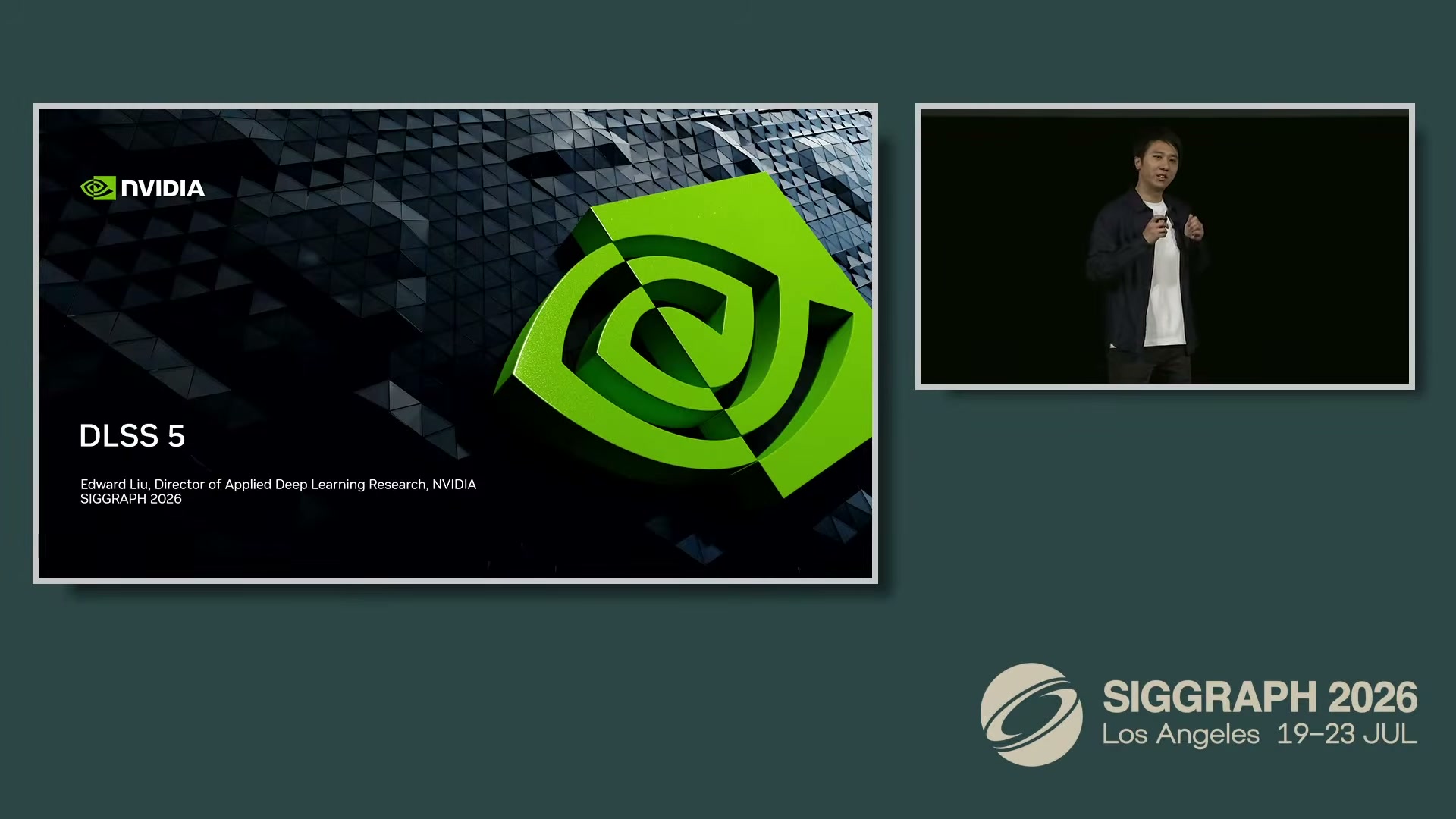
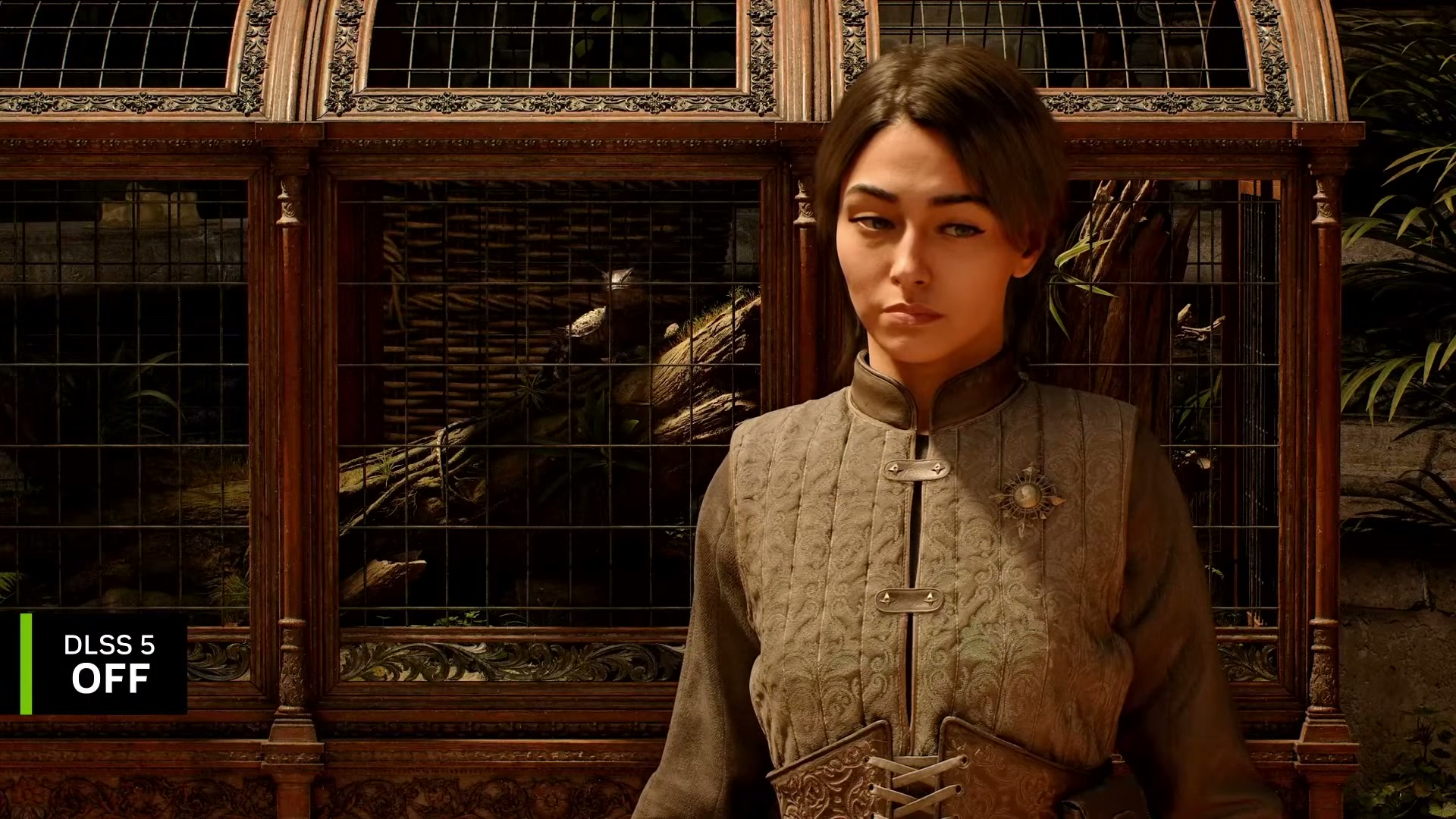
The centerpiece was DLSS 5, presented by Edward Liu, NVIDIA's director of applied deep learning research and the technical lead behind DLSS. The pitch is simple to say and radical to build: "The renderer keeps building the world exactly as the game has authored it, and generation becomes the learned stage afterwards to enrich its appearance." A generative model, distilled from large video foundation models into a one-step, pixel-space diffusion transformer, runs on every frame in real time and repaints the render with the photorealism those big models learned from the real world: subsurface scattering in skin and foliage, believable hair, contact shadows, material response.
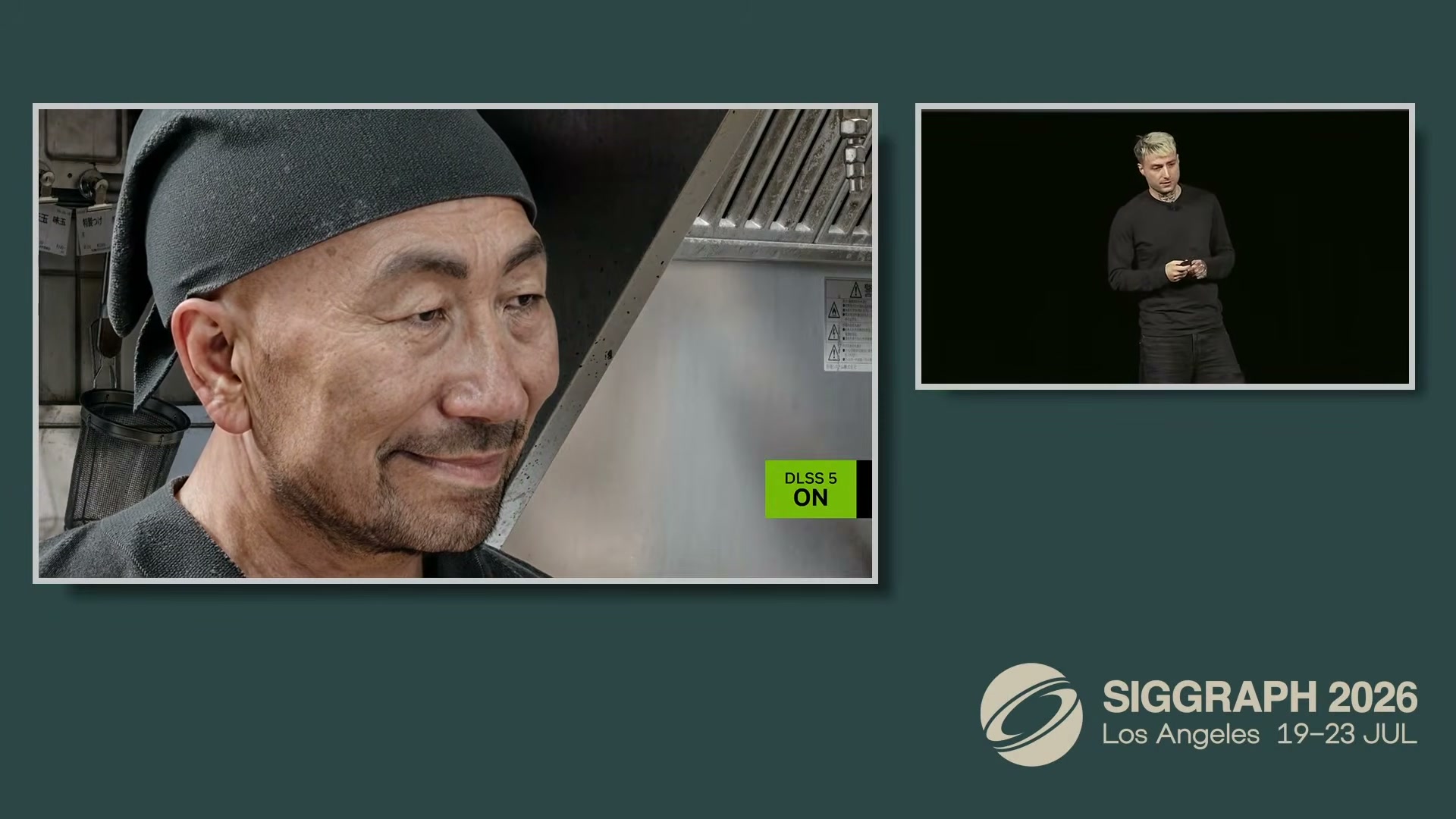
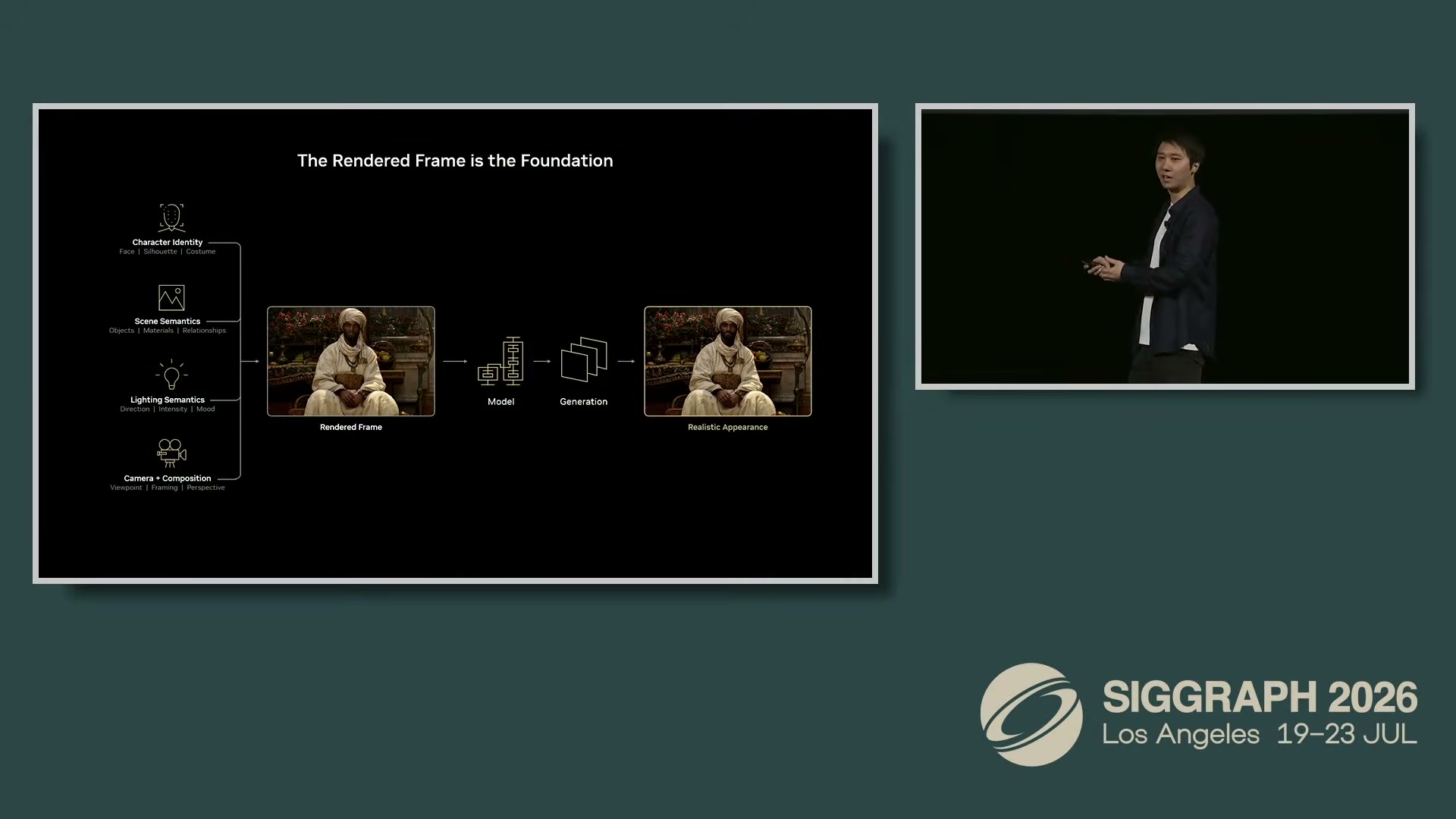
What makes this different from every img2img filter you've used is the conditioning signal: not a prompt, a reference image, or a proxy scene, but the renderer's own output, plus its internal buffers (albedo, surface normals, lighting) and motion vectors. That grounding is what lets the model enhance without inventing. Liu was blunt about why: "Say the hero has a scar and the model just doesn't like it — it removes it. The image now looks cleaner, but it's the wrong character." DLSS 5 is trained to treat the render as canon. It runs causally, one frame in, one frame out, no lookahead, no shimmer, and it fits in the leftover milliseconds of a 60 fps frame budget precisely because it was distilled down to do only one thing. In Liu's words: "It just cannot generate funny cat videos anymore."
It ships this fall, and it extends existing pipelines (path tracing, rasterization, hybrid) rather than replacing them.
The artist controls are the real announcement
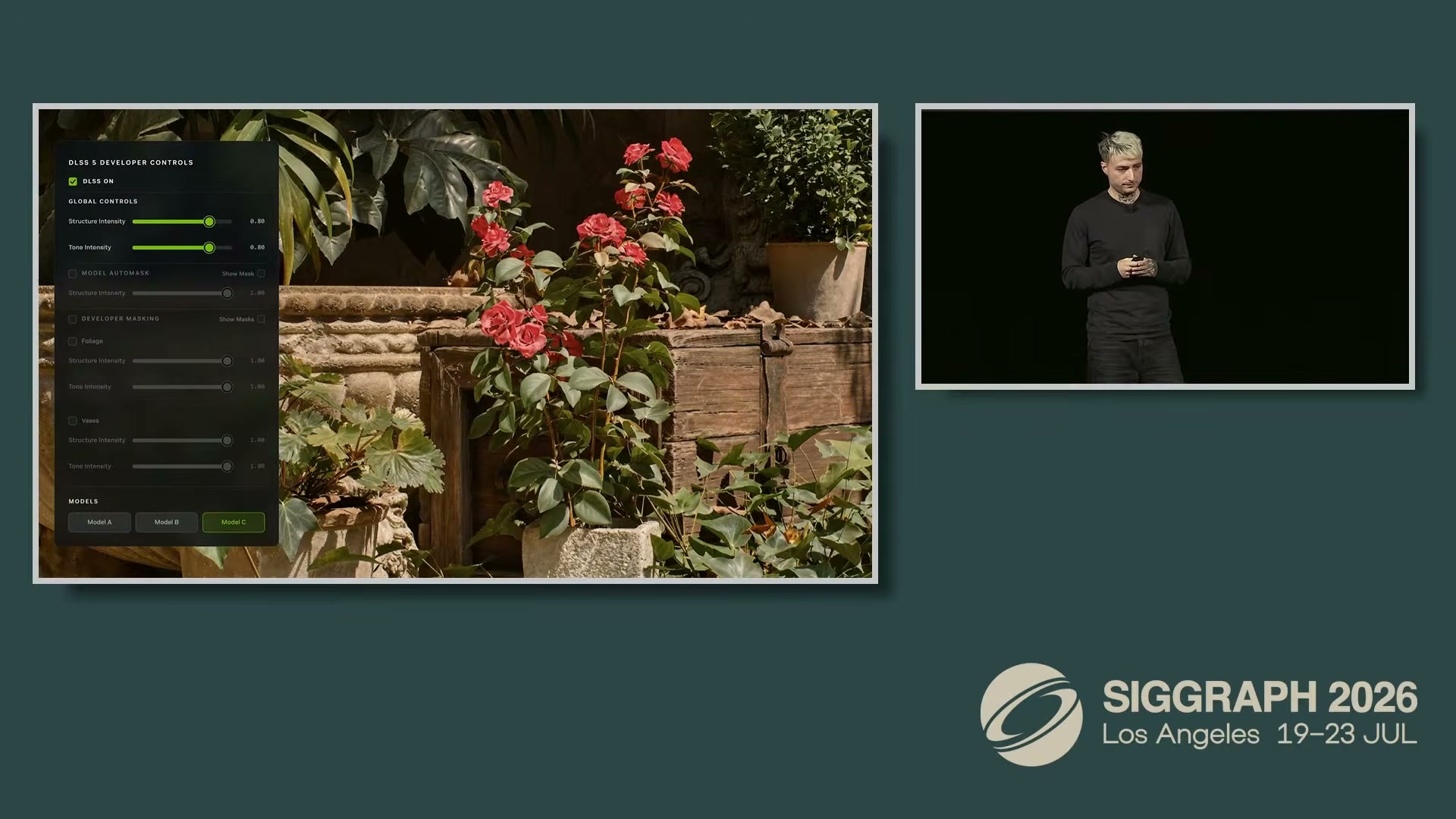
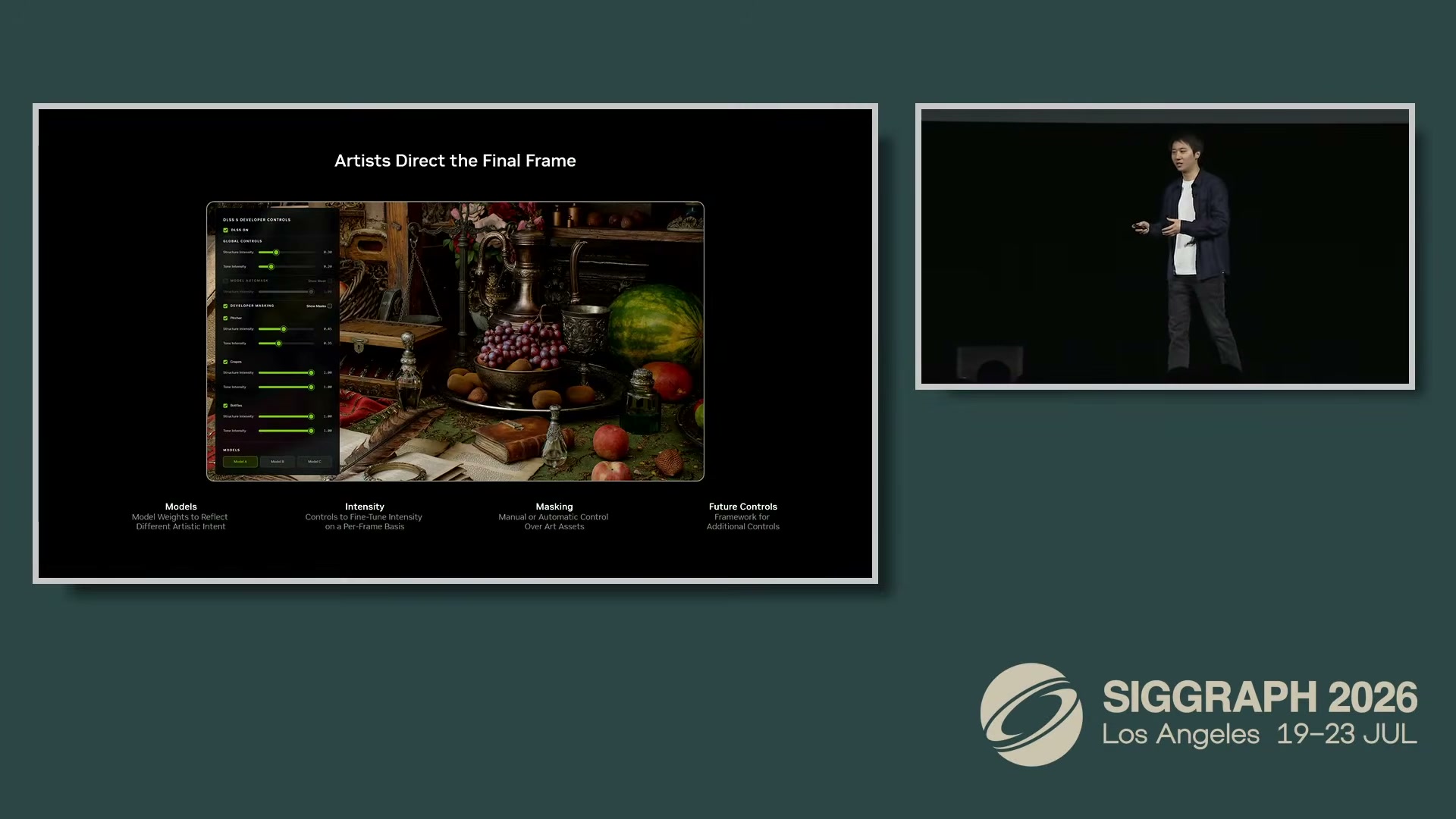
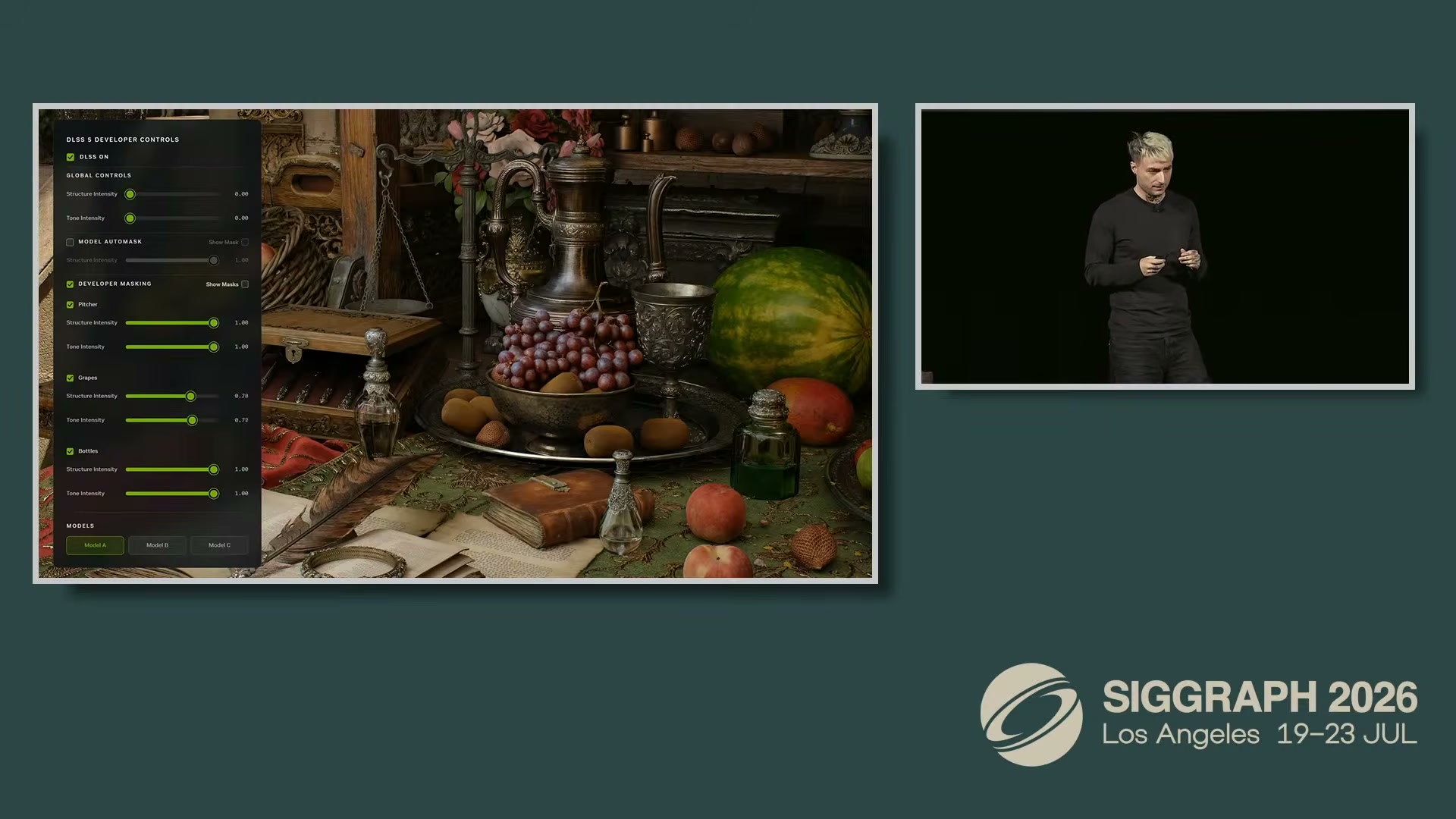
For this site's audience, the demo that followed matters more than the model. An NVIDIA artist walked through the control surface being built for DLSS 5, and it's the clearest picture yet of what "art-directing a generative model" looks like when it's done seriously:
- Multiple models (A, B, C) trained to different looks. Pick per scene, per cutscene, mix and match; choosing one doesn't lock your game into it.
- Structure intensity and tone intensity sliders: high-frequency detail (ambient occlusion, subsurface scattering, reflections) and low-frequency lighting/color, dialed independently.
- Semantic auto-masking from the model side: the model understands what the character is, so you can apply enhancement to the character only, or the environment only, with no engine work.
- Engine-side masks for anything else: in the demo, a pitcher, grapes, and bottles each got their own independent intensity and tone controls.
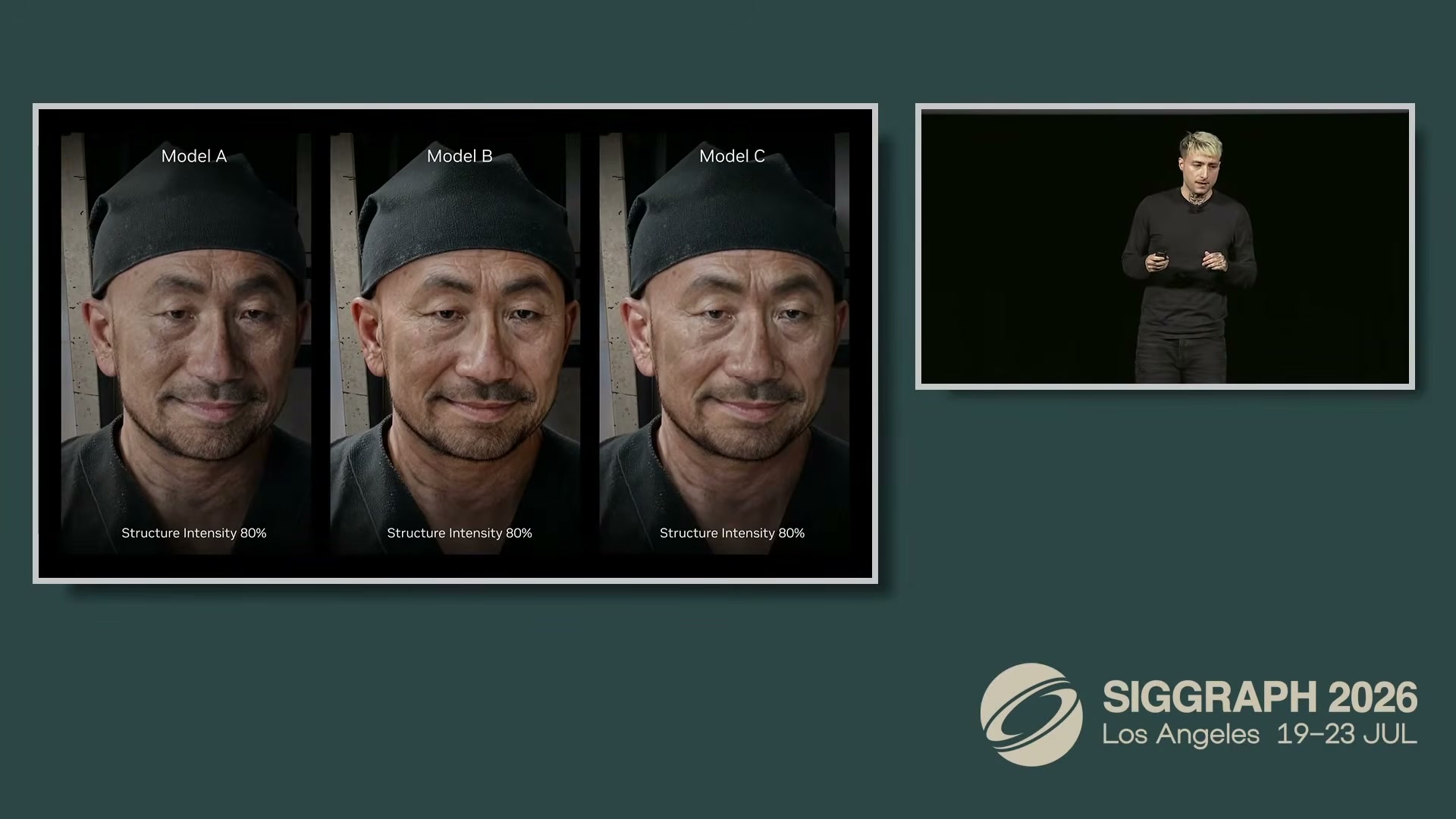
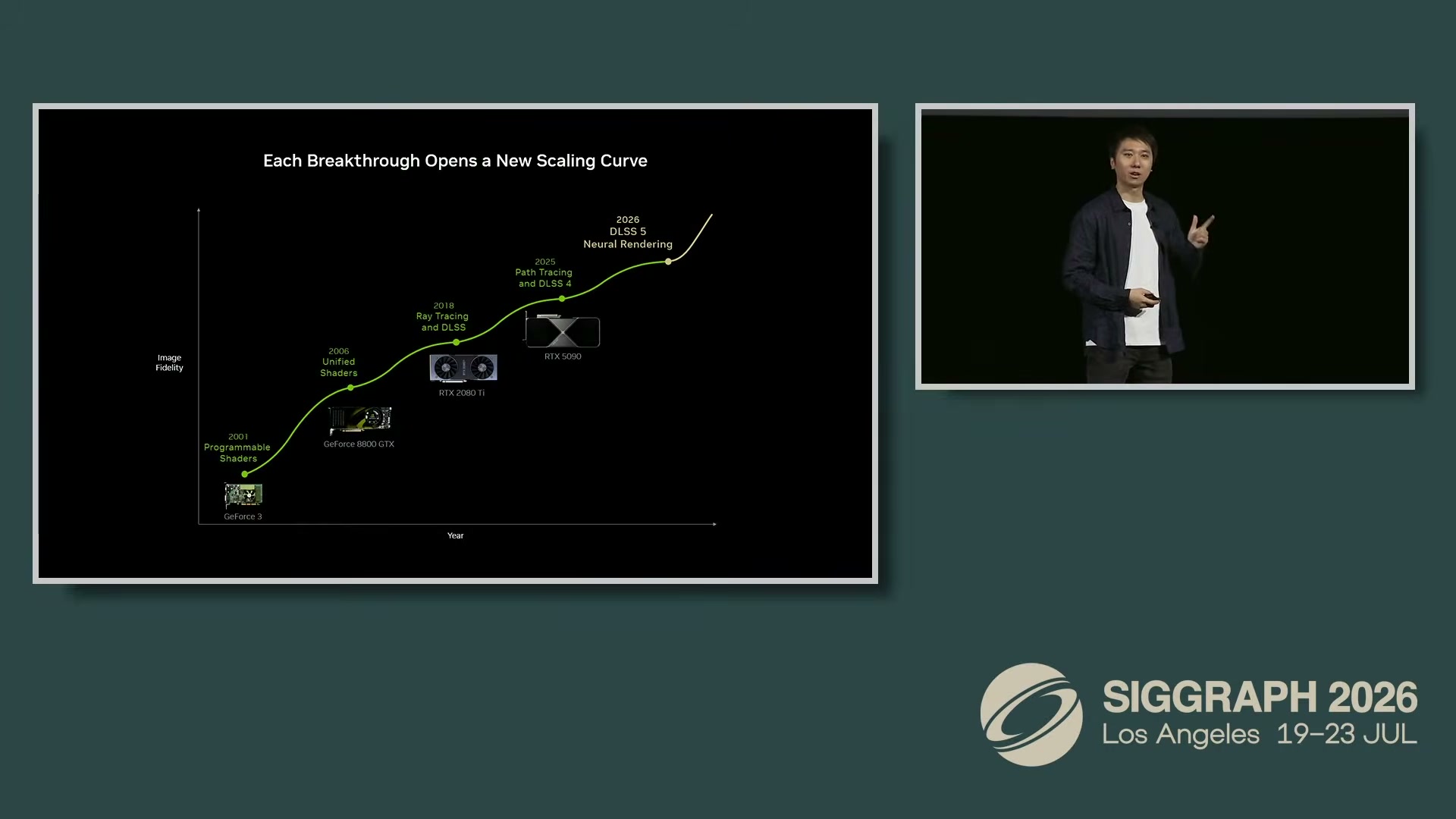
Liu placed this historically, and his framing is the line to remember. AI in real-time rendering had two categories, reconstruction (DLSS upscaling) and function approximation (neural radiance caches, neural materials). "DLSS 5 is adding a third: generation… and artistic direction now becomes the new ground truth." There is no reference image to match anymore; the target is what the art director says it is. Which look, where, and how strong "are all artistic calls, and they belong to the people making the game, not the model."
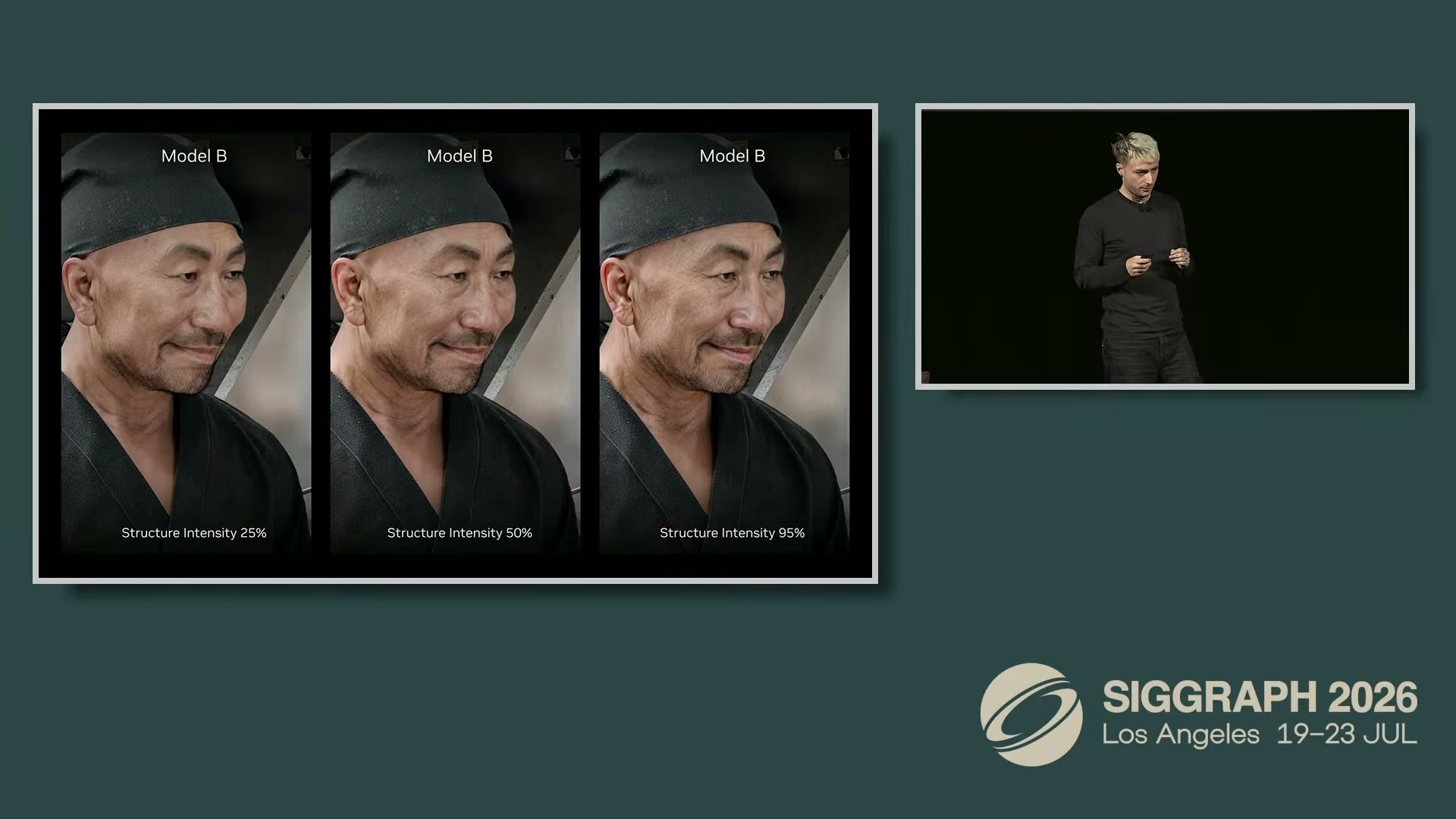
Liu made one more strategic point worth internalizing: image quality now has a second scaling lever. For thirty years the only way to better pixels was a bigger render (more rays, more triangles, higher-res textures). Now training-side improvements, better data and better loss functions, translate directly into better frames at runtime, at zero additional runtime cost. Games effectively inherit an annuity from the offline AI world.
Cosmos 3: open world models, small enough to own
The second act belonged to Ming-Yu Liu, VP of NVIDIA's Cosmos lab, and it opened with the best aphorism of the keynote: for physical AI, "data stops being something you collect — it becomes something you compute." Cosmos is NVIDIA's open world foundation model: a mixture-of-transformers architecture where an autoregressive tower reasons about the world (a vision-language model that watches and explains) and a diffusion tower generates it (video, audio, and, critically, actions), tied together by shared multimodal attention.
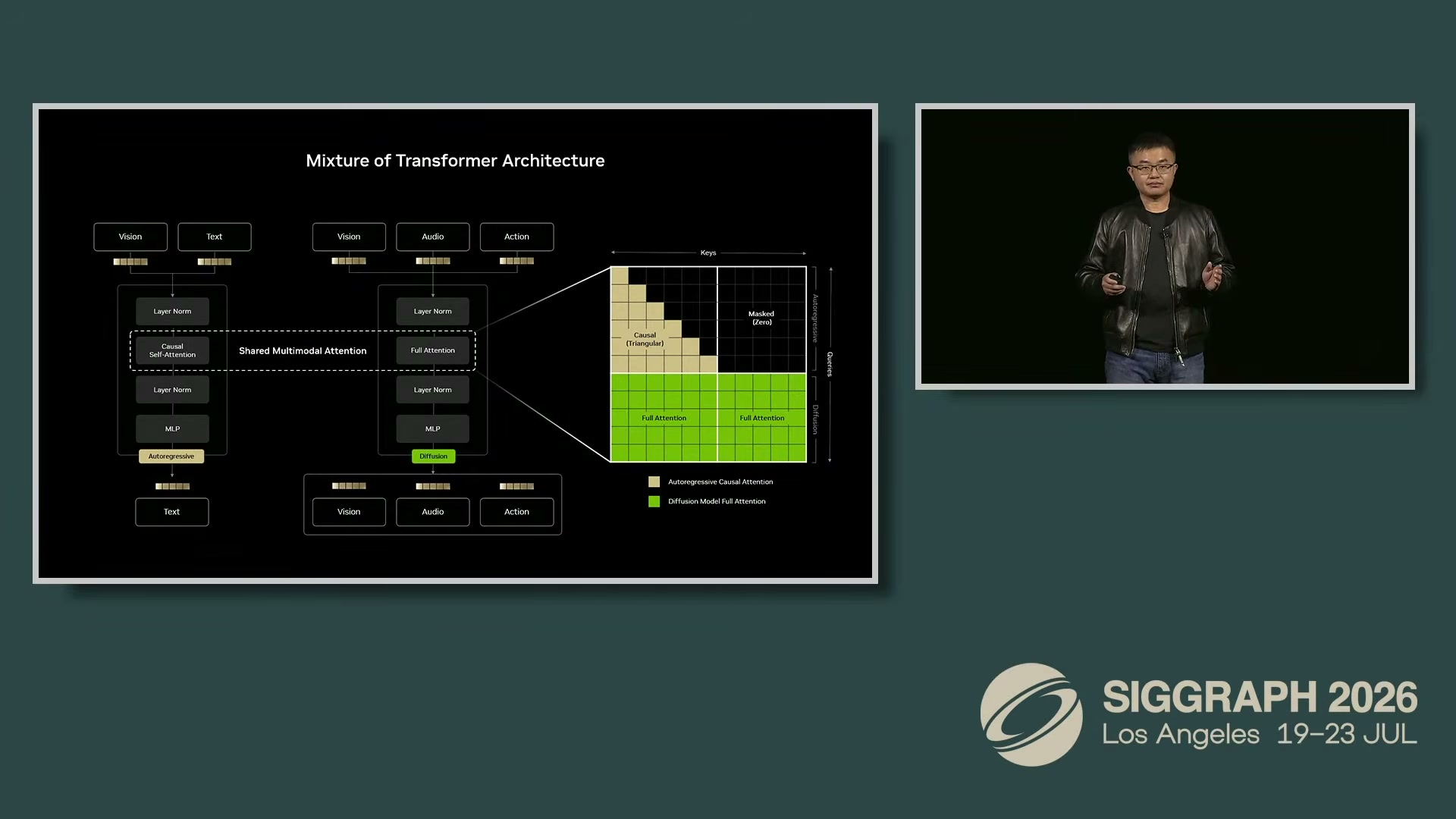
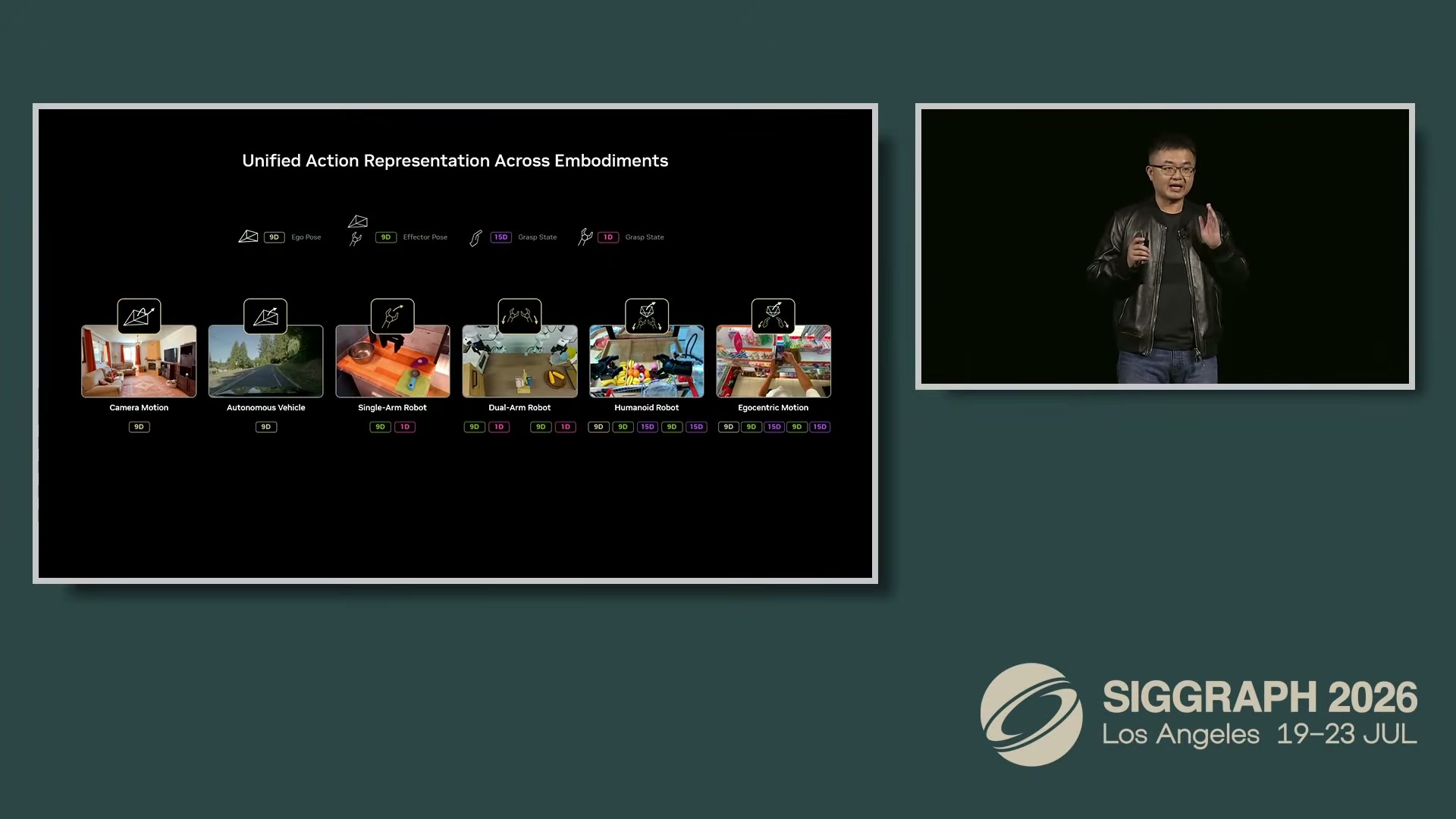
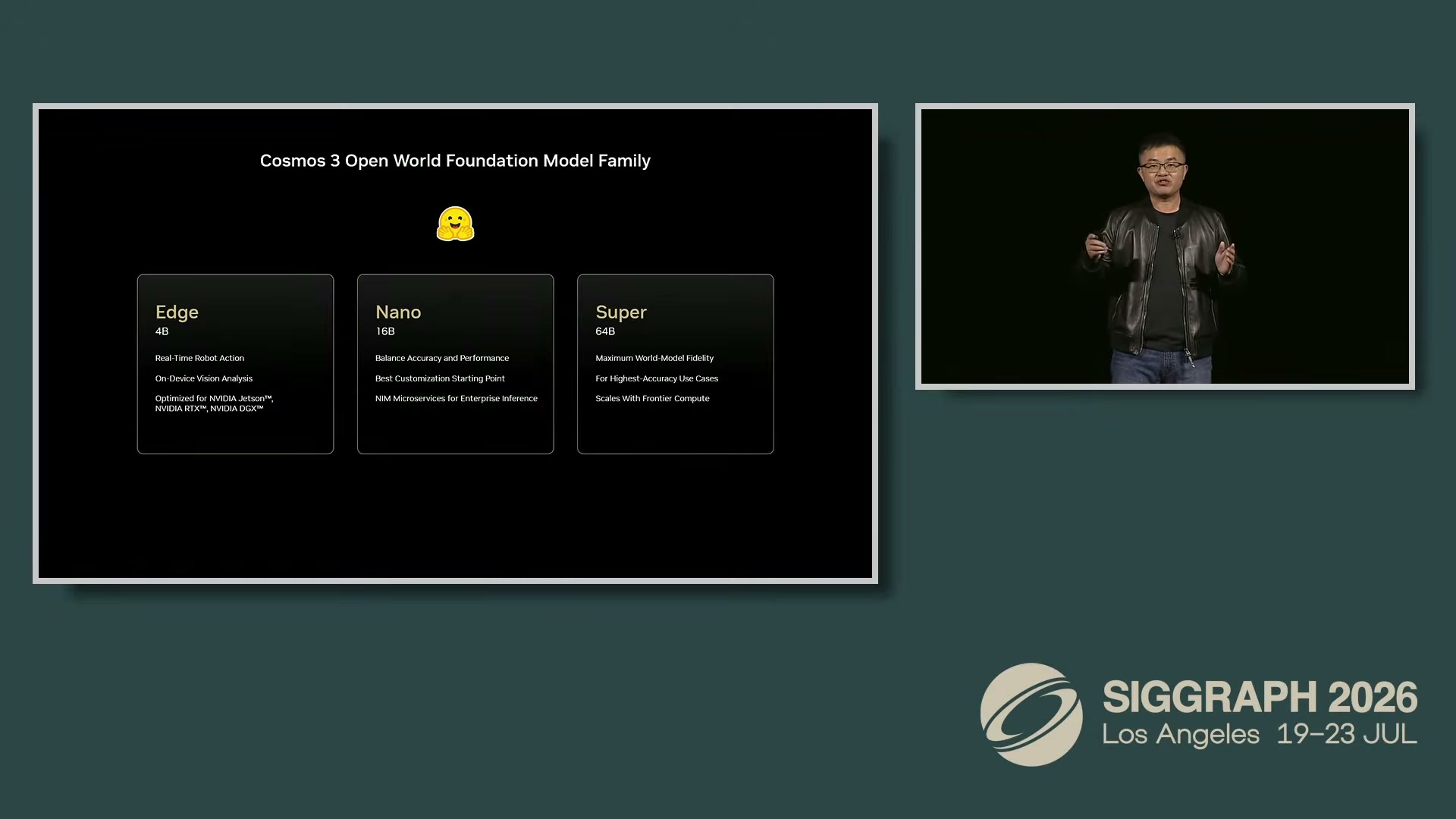
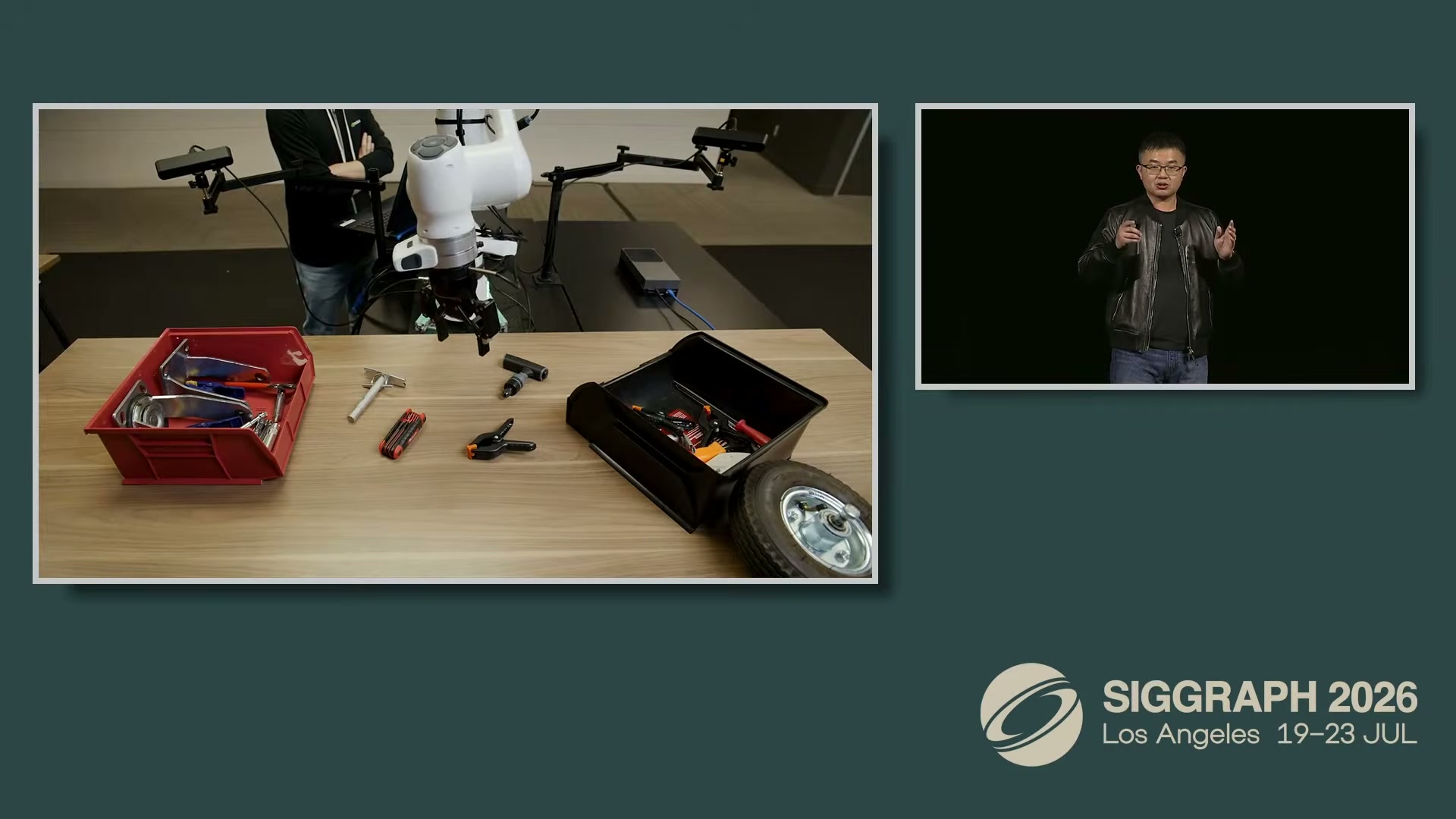
Cosmos 3 Nano and Super shipped last month; the keynote added the final member, a 4-billion-parameter edge model built "for a single purpose: run real time on devices." It drove a robot arm live on stage from a Jetson Thor, camera-to-action, no data center round trip. Post-training got the same treatment: distribution matching cuts diffusion to four denoising steps, a 25× speedup for text-to-image and image-to-video generation, and NVIDIA is releasing the post-training scripts it uses internally, sized to run on a DGX station. Everything is open: models, datasets, libraries, frameworks. Actions are modeled as a common vocabulary of geometric primitives (ego pose, end effectors, grasp), which has a lovely side effect: every human egocentric video becomes valid robot training data.
Cosmos Dreams: a playable world on one workstation GPU
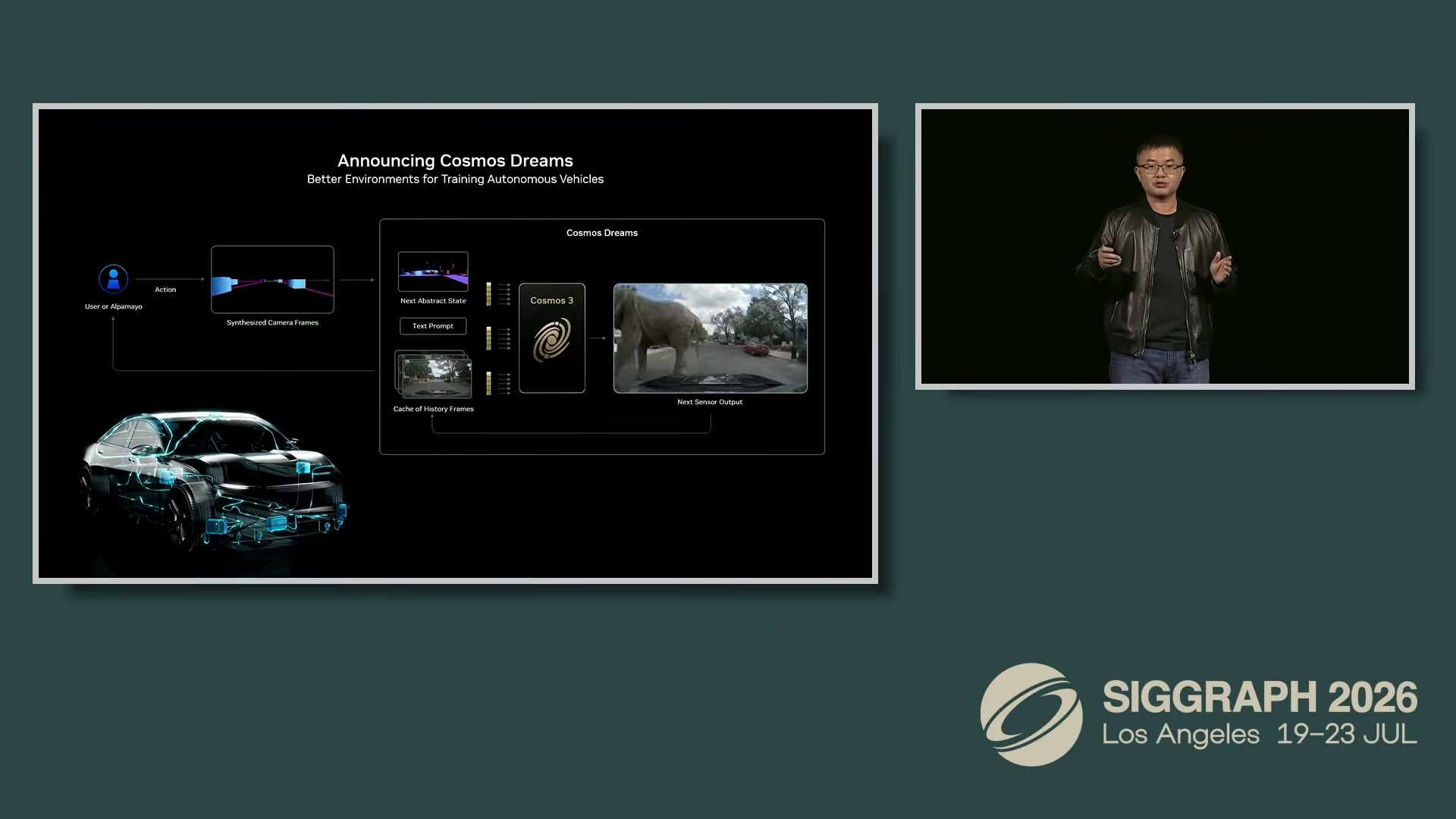
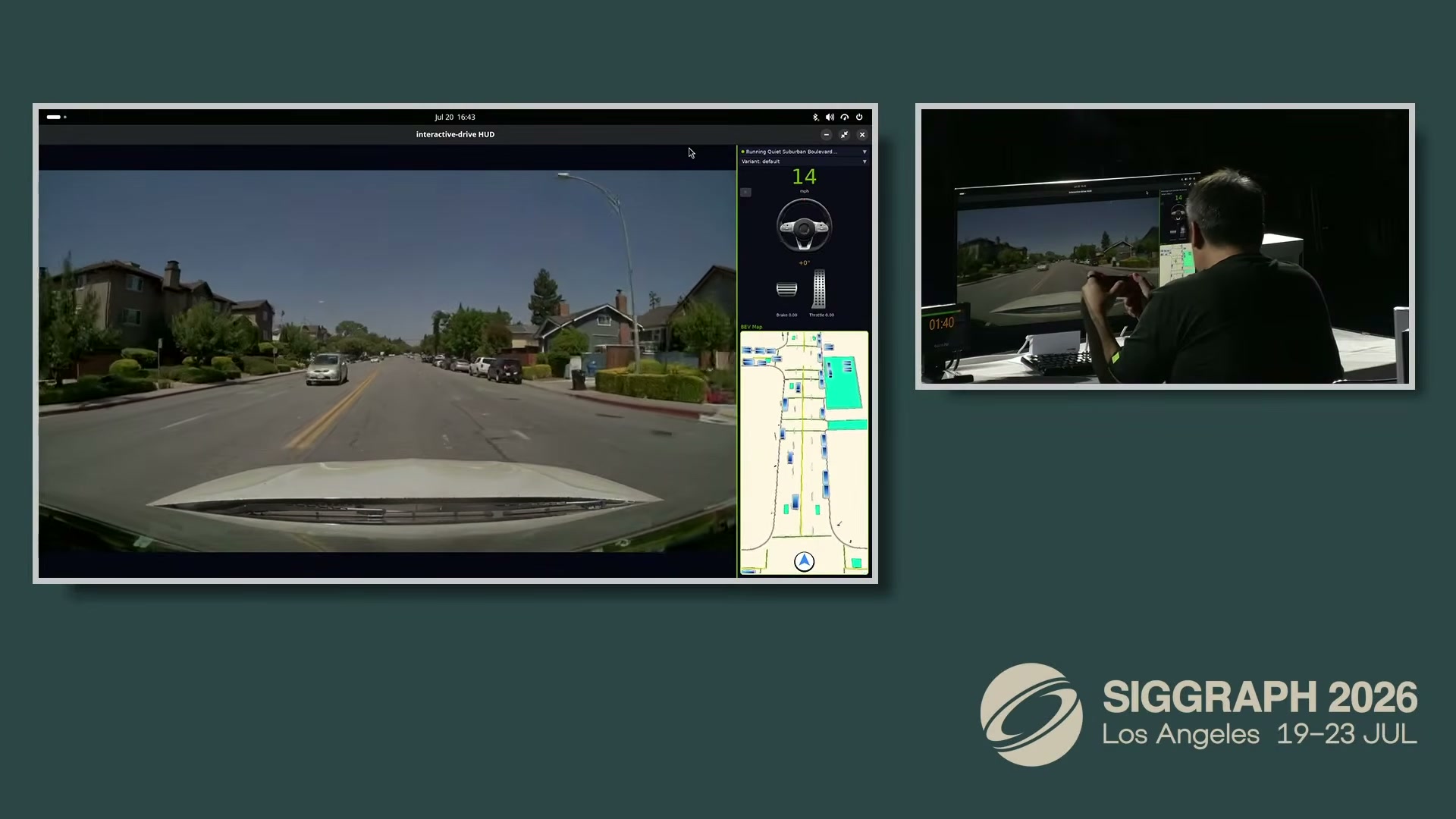
The demo of the night was Cosmos Dreams, a "neural closed-loop simulator" built on Cosmos, the first one targeting autonomous vehicles. From a single starting frame, the model generated an entire drivable suburban world, photorealistic, frame by frame, conditioned live on a PS4 controller. "Your car basically drives in the imagination of Cosmos Dreams."
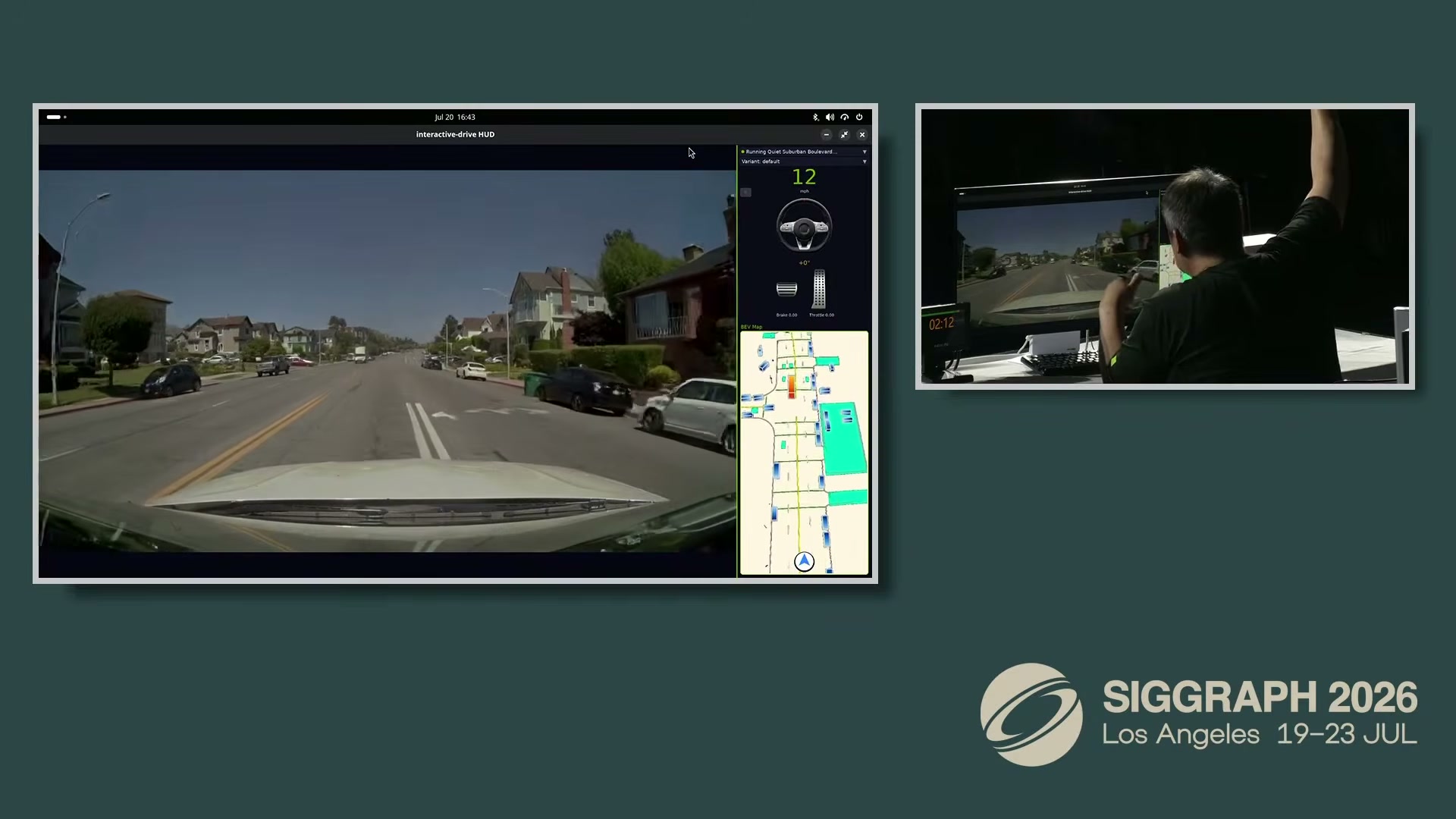
GenMedia people should clock the hardware trajectory. When the team first built the demo, it needed 64 GB300 data-center GPUs. Then 16 Vera Rubin GPUs. Now it runs on a single RTX Pro 6000 workstation card, the kind of machine a small studio already owns. Interactive, promptable, physics-aware world generation went from "supercomputer" to "under the desk" inside one development cycle. Whatever you think interactive video and generated game worlds become as a medium, this is the capability curve they'll ride.
AI physics: cinema-grade simulation at conversation speed
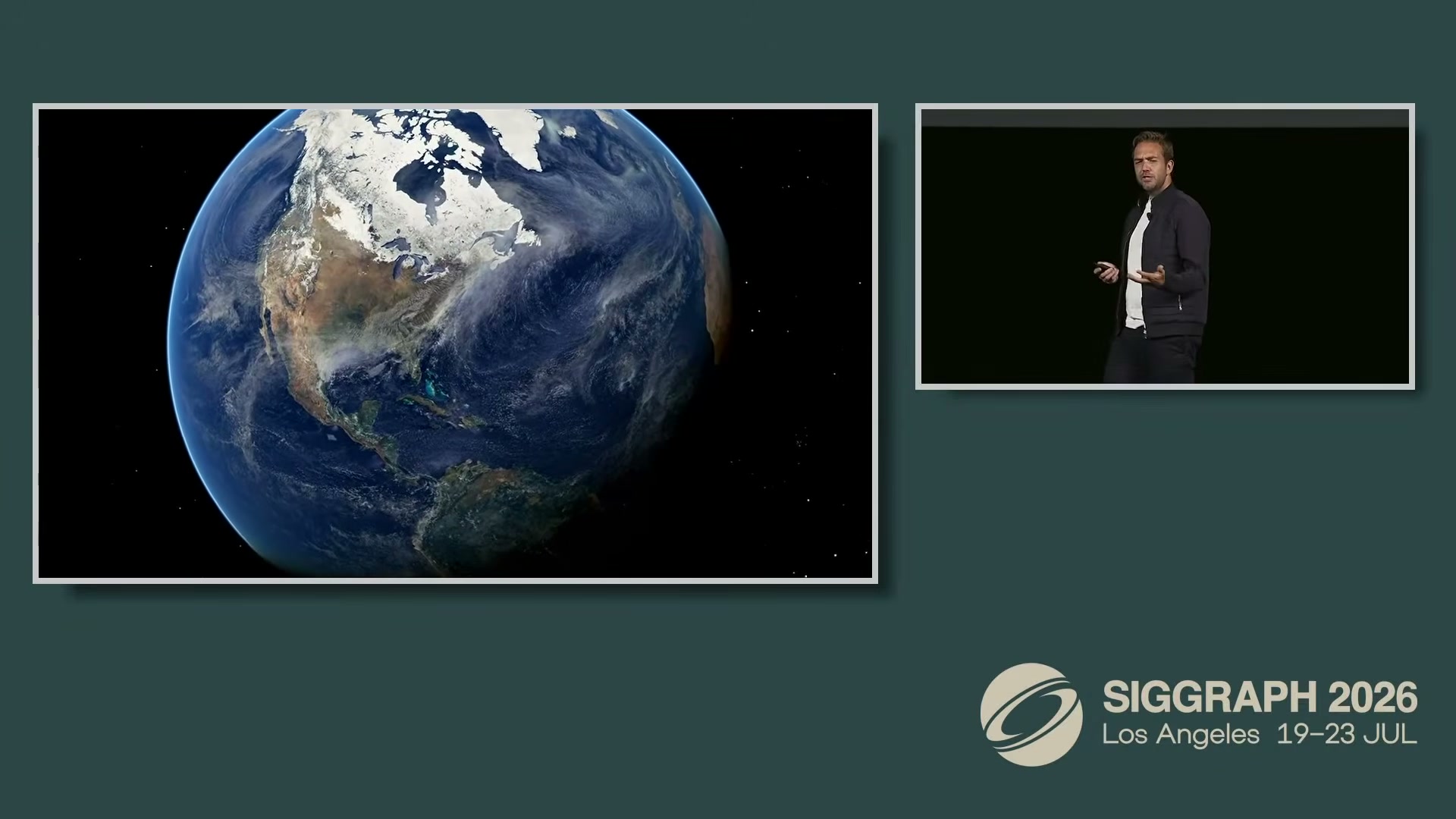
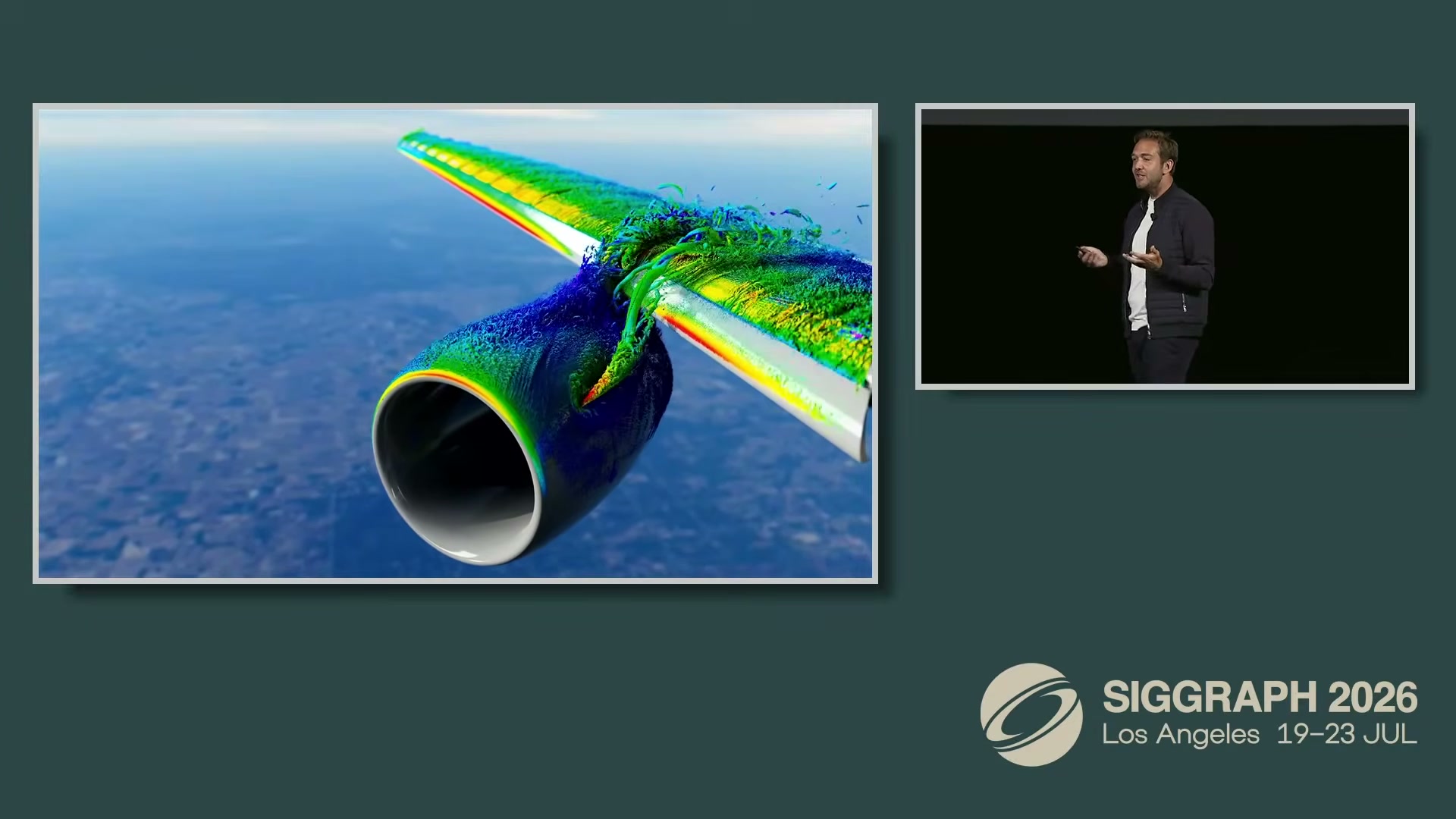
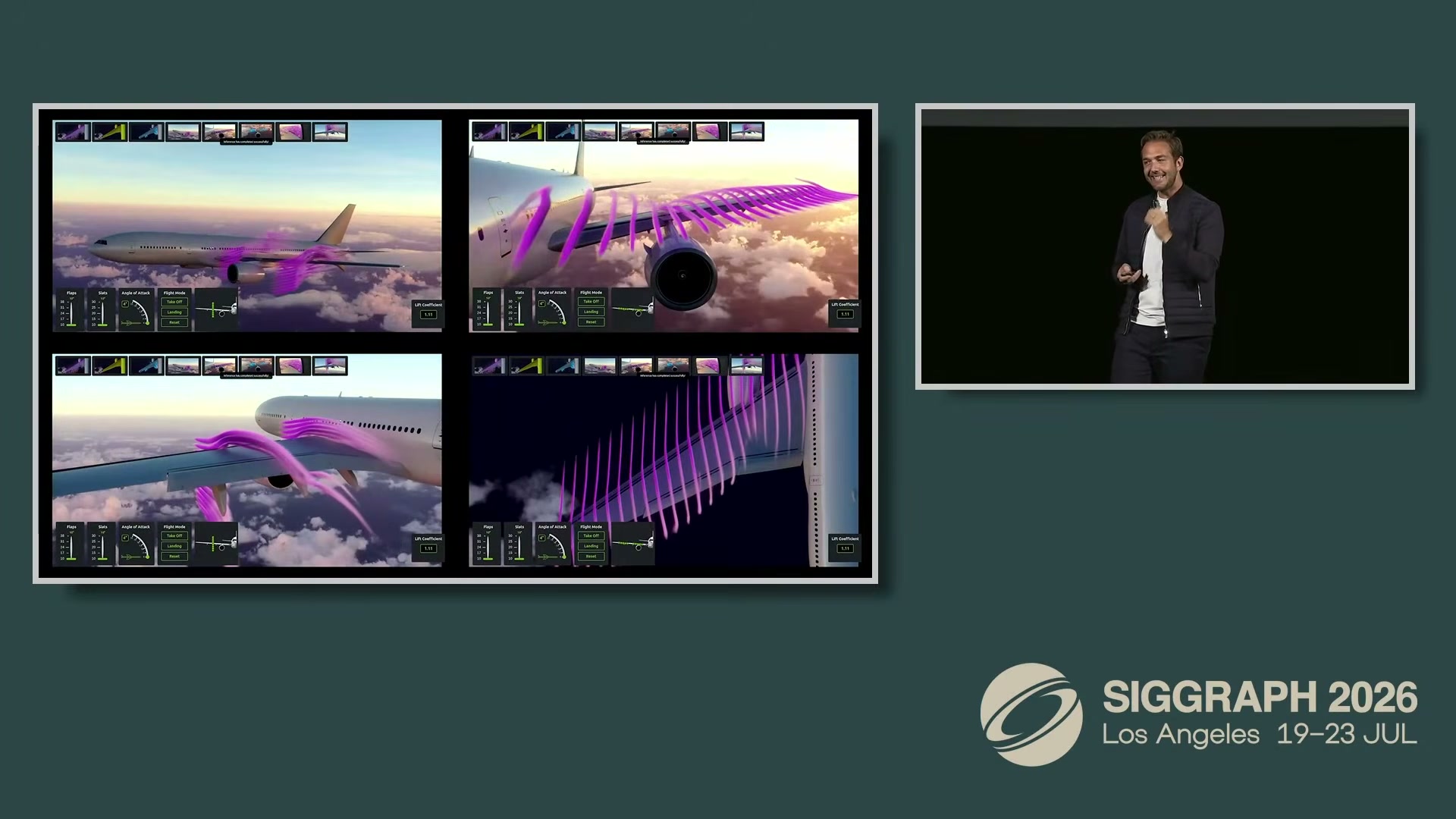
Between the two generative acts, NVIDIA's Neil Ashton made the case that the same trade is available in physics. The reference points are extreme (a Gordon Bell Prize-winning Earth simulation on 20,000+ GPUs, aircraft CFD with a billion degrees of freedom), but the punchline is the compression: a dataset of 2,000 aircraft simulations weighing 200 terabytes trains a transformer whose checkpoint is 200 megabytes, predicts unseen geometries 10,000× faster, and lands within one to two percent of ground truth. He showed it running interactively: change the plane's angle, get physically-representative flow in about a second on an RTX 6000, visualized through Omniverse.
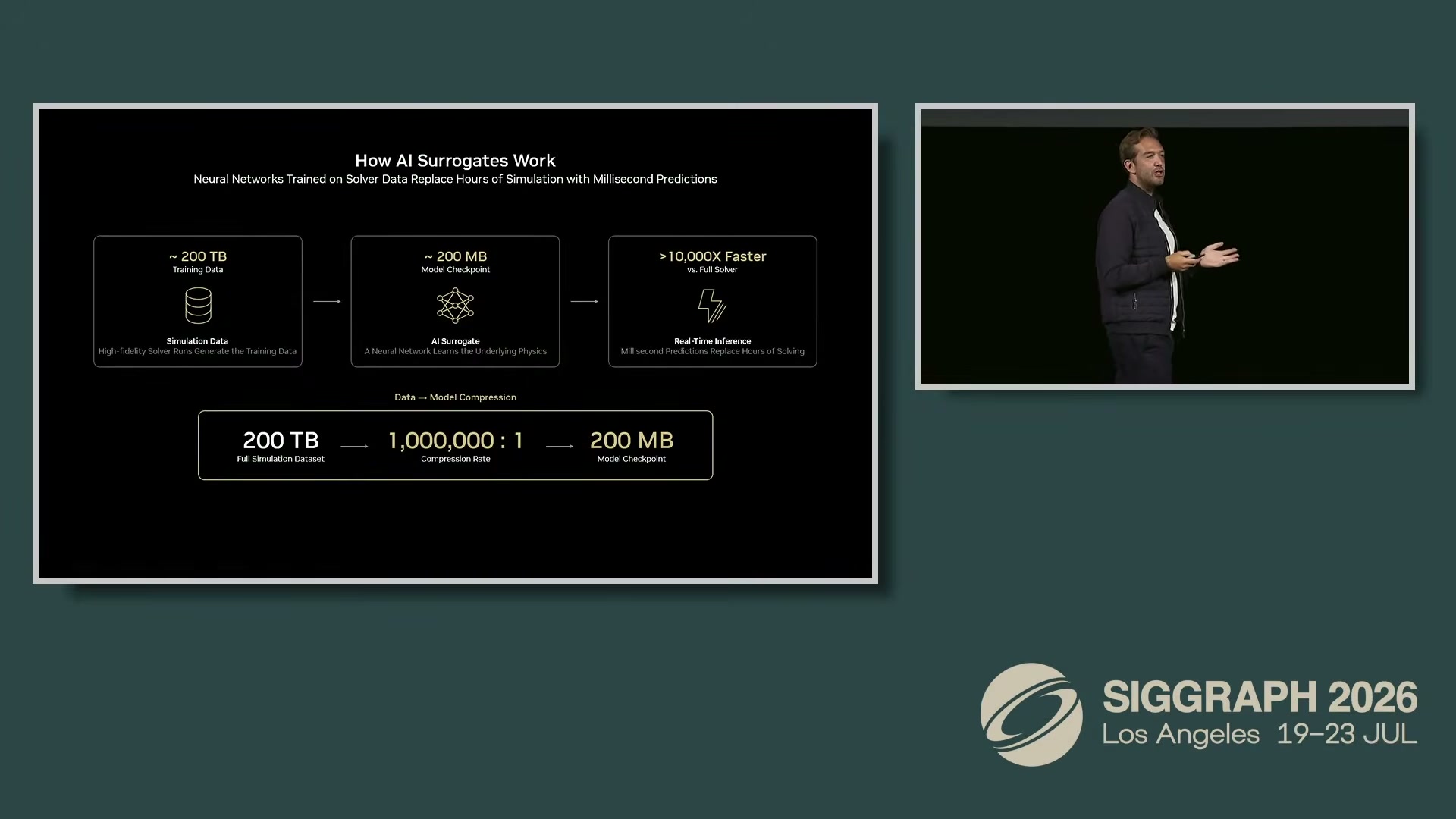
His ask to the room was aimed squarely at this community: the people who model water, smoke, and cloth for film pioneered the differentiable-physics and geometry methods this work is built on. Bring that expertise to engineering, and take the 10,000× speedups back to VFX. The frameworks (PhysicsNeMo, Earth-2) are open source.
What can you do now that you couldn't before?
The user-facing question, answered plainly:
- Art-direct a generative model per object, per frame, in real time. Masks and sliders instead of prompt roulette, with the model guaranteed to preserve your geometry, characters, and story. That combination did not exist before DLSS 5.
- Get "expensive" light transport for free. Subsurface scattering on foliage and skin, contact shadows, and material response that would blow any real-time budget now arrive as a learned enhancement pass, and improve every time the model retrains, with no runtime cost.
- Run and own a world model locally. A 4B world model does real-time policy on a Jetson; a full interactive world simulation runs on one RTX Pro 6000; post-training runs on a DGX station with NVIDIA's own released scripts. Frontier world models stopped being an API you rent.
- Generate 25× faster. Distribution-matched Cosmos models cut diffusion to four steps for text-to-image and image-to-video: interactive iteration on what used to be a coffee-break render.
- Treat physics as an interactive material. Physically-correct simulation in seconds instead of days turns previz, FX lookdev, and design exploration into a live conversation instead of a queue.
- Mine video for embodied data. Cosmos's inverse dynamics turns ordinary (including egocentric) video into action-labeled training data, the raw material for robot, avatar, and character-behavior work.
Where is NVIDIA focusing?
Read the whole keynote as one argument and NVIDIA's focus is unmistakable: grounded generation, meaning generation constrained by renders, physics, and world state rather than free-floating text-to-video. Jensen said it in one sentence: "We want the power of AI, but grounded in 3D, governed by physics, so that it is shapable by creators." The company is placing that bet on three connected fronts: neural rendering inside the game loop (DLSS 5), world foundation models as the data engine for physical AI (Cosmos, robotics, AVs), and AI-accelerated simulation for science and industry (PhysicsNeMo, Earth-2). Notice what wasn't announced: a media-generation app. NVIDIA is building the substrate where graphics, physics, and generation converge rather than competing with your video model, and betting that games, film, robotics, and digital twins all end up needing the same thing: "virtual worlds that behave with the fidelity and realism of the physical world."
For GenMedia people, the strategic read is that the render frame, not the text prompt, is becoming the premier conditioning signal for generative imagery, and the 3D scene is becoming the control rig for AI. The studios that keep authoring worlds in 3D get to drive the generative layer with precision that prompt-based workflows can't touch, which raises the value of Maya, Houdini, and engine skills rather than obsoleting them.
Quotes worth keeping
"You stand at the intersection of art, science, and engineering. You are the da Vinci of our time. This is your moment." — Jensen Huang, to the SIGGRAPH audience
"Simulation defines the world, generation enriches its appearance, and artists direct the outcome. Not AI replacing graphics — AI extending graphics." — Edward Liu
"Every pixel in a game is there because somebody wants it to be there. DLSS 5 was built to keep it that way." — Edward Liu
"Artistic direction now becomes the new ground truth." — Edward Liu
"Data stops being something you collect — it becomes something you compute. Compute is data." — Ming-Yu Liu, VP, NVIDIA Cosmos
What it means for GenMedia jobs
- "AI art direction" is now a shipped, named workflow: masks, sliders, and model selection over a generative layer. Expect it in tech-art and lighting job descriptions within a year, the way "PBR" and "DLSS integration" spread after their SIGGRAPHs.
- Real-time and film pipelines keep converging on the same skills: whoever can ground a generative model in renders, G-buffers, and physics is employable in games, VFX, robotics, and automotive simultaneously. That's four industries bidding on one skill set.
- Local, open world models lower the studio barrier again. A Cosmos-class model post-trained on a workstation puts world-simulation R&D, the kind that trained NIGHTBORNE-era video models, within reach of small teams, not just labs.
- Simulation artists have a second market. NVIDIA explicitly recruited SIGGRAPH's water/smoke/cloth experts into engineering AI; the flow goes both ways, and it pays.
NVIDIA spent the hour arguing that graphics people invented the tools that sparked modern AI, and that AI is now returning the favor. Whether "the da Vinci of our time" lands as flattery or recruitment, the concrete facts stand: this fall a generative model ships inside the renderer with art direction as its interface, and a playable generated world runs on a card you can buy. We'll keep tracking who gets hired to build on both.